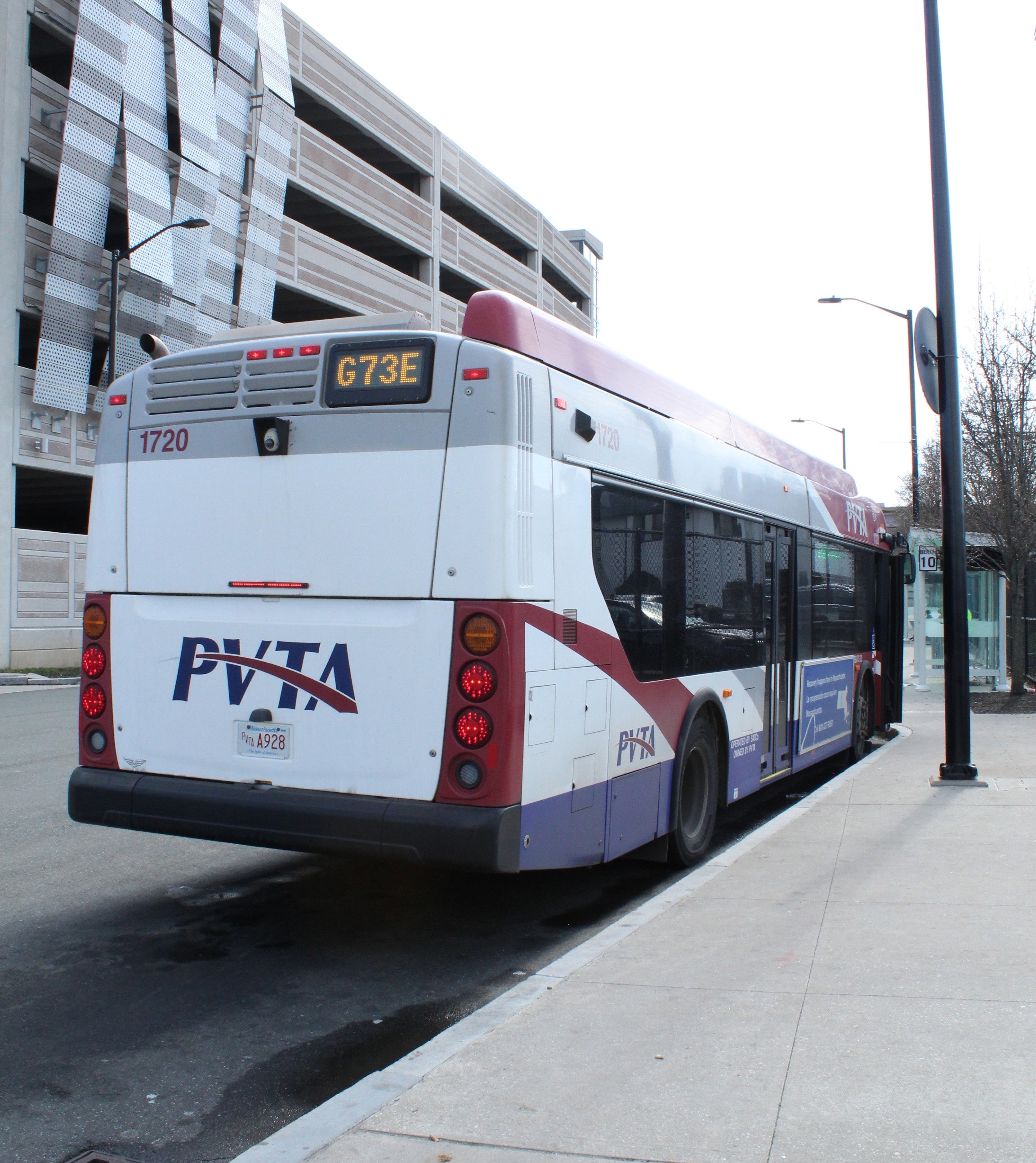
For riders like Sarah Hougen, a Northampton resident who does not own a car, the shift to fare-free transit in the Pioneer Valley has changed how she uses the system.
“It gives me the permission to ride more of the in-between things that I wouldn’t normally choose. I wouldn’t want to pay $1.50 to just go this little distance,” Hougen said.
Hougen, who has mobility issues that make walking difficult, said the cost savings have made it easier to rely on the Pioneer Valley Transit Authority (PVTA) for everyday trips, including errands and physical therapy appointments.
“Sometimes I can’t walk well,” she said. “When it’s free, I don’t feel so bad popping on various little spots, so it does increase frequency.”
With 55 percent of PVTA riders living at or below the federal poverty line and nearly 70 percent reporting that they have no other way to make their trips, it is clear that the system plays a critical role for low-income residents.
Since eliminating fares in 2024, the PVTA has seen ridership increase and productivity rebound to pre-pandemic levels. Yet even as more people ride, data obtained via a public records request from the PVTA, including ridership numbers and General Transit Feed Specification (GTFS) data—a standardized format for public transportation schedules and geographic information—reveal that significant gaps in service coverage and frequency remain, raising questions about who can rely on the system.
Additionally, we conducted qualitative research through a survey posted to the Northampton Facebook group, which hosts nearly 40 thousand members, asking PVTA riders to provide information about their experiences and feelings toward the transit system.
For many riders, service gaps are not just inconvenient. They shape access to jobs, healthcare, and daily necessities, and carry wider implications for economic, racial, and environmental equity across the Pioneer Valley.
Now, the PVTA is planning a series of new bus routes aimed at expanding service to underserved communities, including proposed express lines in Ludlow, Chicopee, and Westfield.
Transit officials say the routes could improve access for hundreds of thousands of residents. But whether they become a reality depends on a familiar constraint: funding.
These potential new routes come at a pivotal moment for the Pioneer Valley’s transit system. In June 2024, the PVTA eliminated fares as part of the Try Transit initiative, a program backed by $30 million of state funding to expand access and increase ridership across the system’s 24 member communities.
Following a 27 percent increase in ridership—from 7.3 million riders in 2024 to 9.3 million the following year—and additional funding allocated by the Healey-Driscoll administration in subsequent budget cycles, the PVTA announced in July 2025 that the Try Transit program would be extended through June 2026.
“A large portion of our population is low-income and minority,” said PVTA Administrator Sandra Sheehan. “The push was to kind of equalize some of the disadvantages that those individuals have.”
Before fares were lifted, the cost of riding posed a visible burden for some passengers. Sheehan recalled seeing riders sorting through coins to pay for a daily pass. “You could see that they had some issues struggling to make ends meet,” she said.
Ridership and Geospatial Data
Before fares were lifted, the cost of riding posed a visible burden for some passengers. Sheehan recalled seeing riders sorting through coins to pay for a daily pass. “You could see that they had some issues struggling to make ends meet,” she said.
On the right, is a visualization highlighting PVTA ridership over time.
Ridership initially hovered between 10 to 12 million riders from 2015 to 2018.
After a sharp decline amidst the pandemic era, ridership reached an all time low of 3.9 million riders in 2021.
As of recent, ridership has steadily rebounded and is quickly approaching pre-2020 levels. Following the introduction of the Try Transit initiative, ridership increased by 27 percent, from roughly 7.3 million riders in 2024, when fare-free service was implemented, to 9.3 million in 2025.
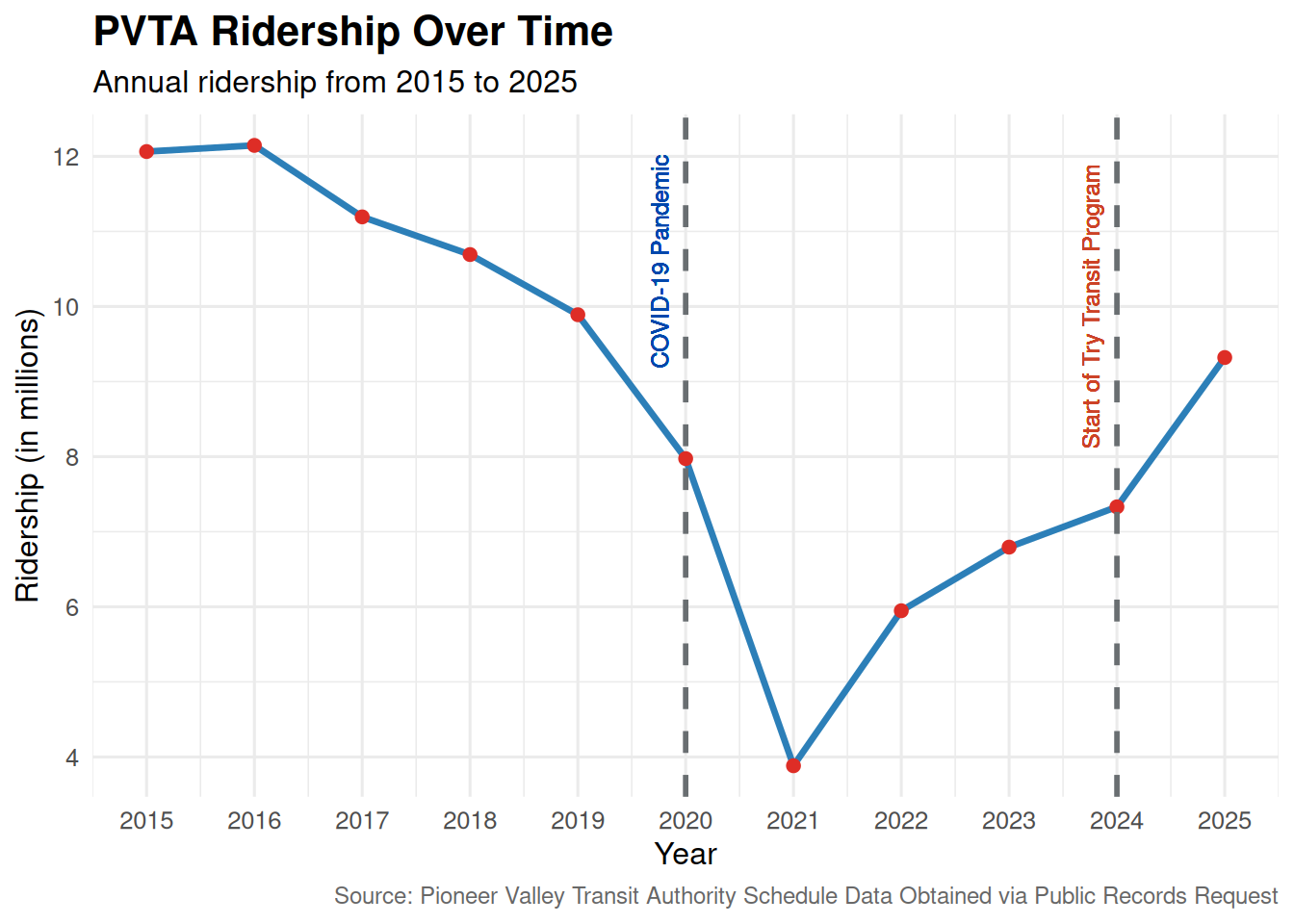
The shift to fare-free transit has since had a measurable impact on PVTA ridership. “The main goal was just to try to encourage people to ride the bus more and try to get us back to pre-pandemic levels of ridership,” said Alex Forrest, PVTA’s Manager of Planning and Analysis. “To that end, the program’s been very effective. I’d say we caught up maybe two years earlier than we would otherwise have caught up.”
Alongside these gains, fare elimination has made the system more productive. PVTA productivity, which is measured as the number of passenger trips per service hour, increased from an operating level of 71 percent of maximum productivity in 2023, to 87 percent in 2025 when fare-free service operated year-round.
However, rider interviews and survey data point to a consistent tension: while free fares have made transit more affordable, they have not made it equally accessible.
To better understand where gaps exist, we mapped transit routes and stops using General Transit Feed Specification (GTFS) data. The analysis focuses on access to essential destinations, including colleges, grocery stores, and healthcare facilities.
The results show a system that works well in some places and falls short in others.
The Pioneer Valley consists of 43 towns.
The PVTA has 24 member communities.
Operating over 50 routes and nearly 2,000 stops.
Transit service is concentrated in denser population areas such as Holyoke, Springfield, and Northampton, while coverage becomes more sparse in outlying communities. Transit planners typically define access as living within a quarter mile of a bus stop, which is about a five- to ten- minute walk.
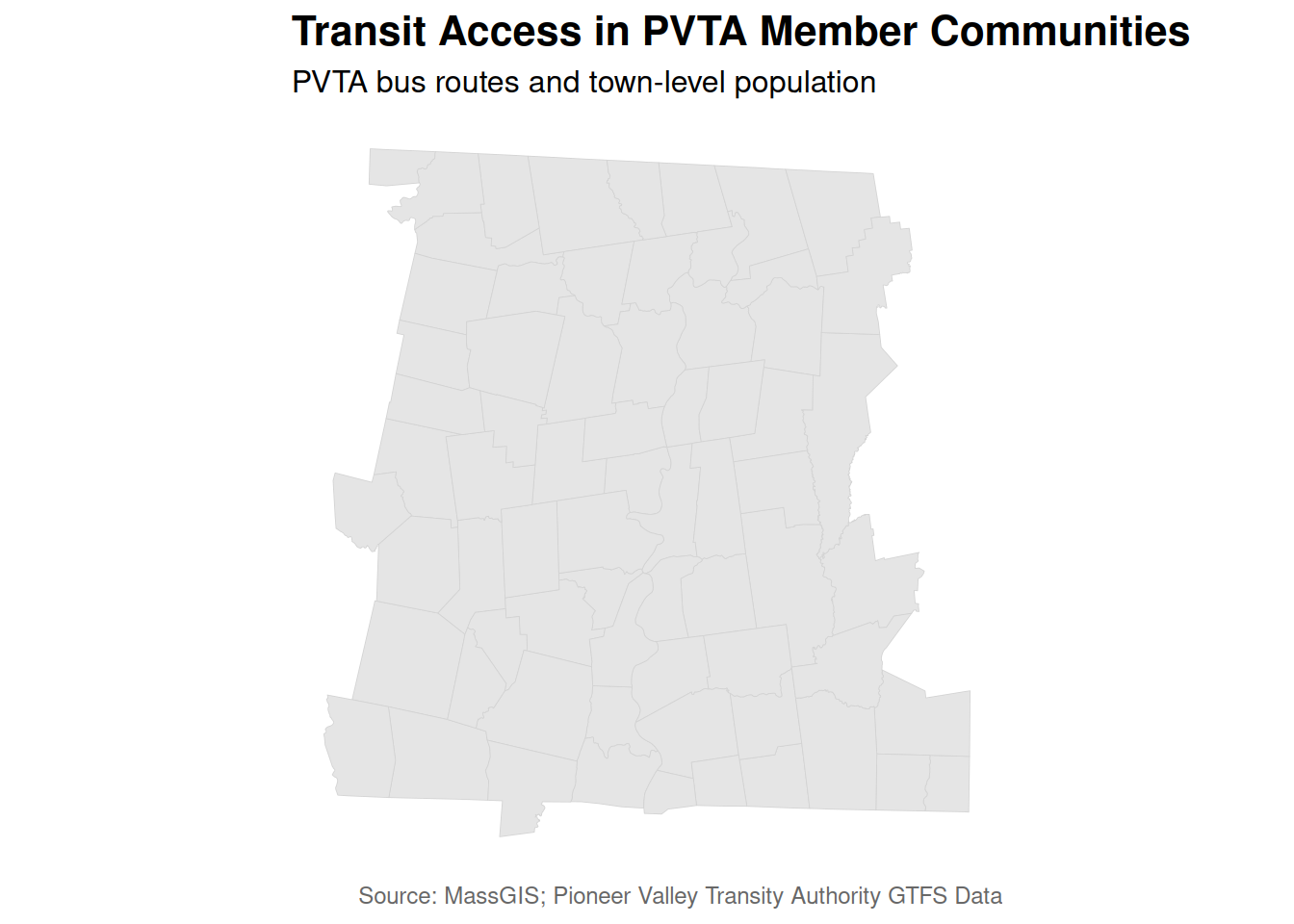
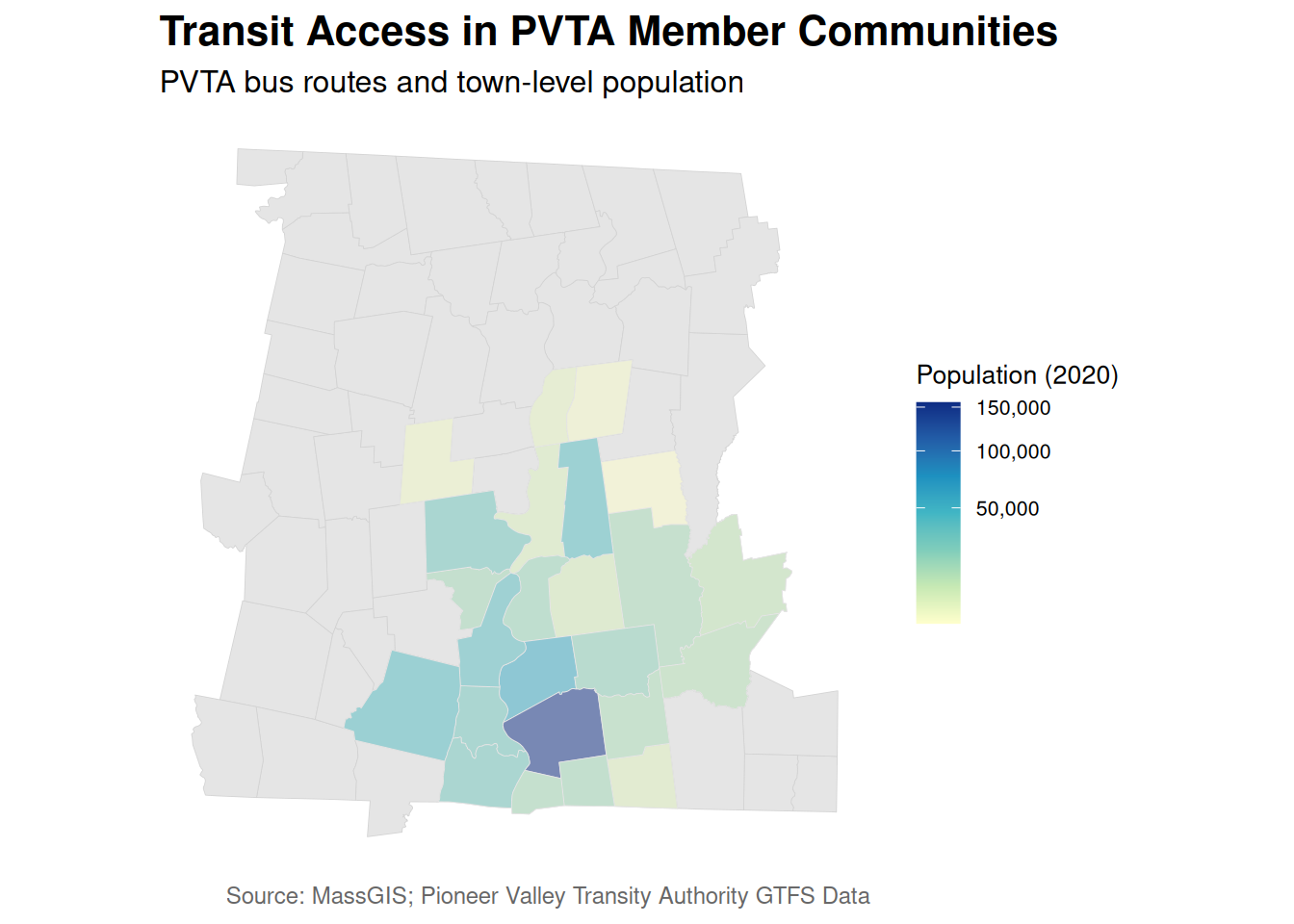
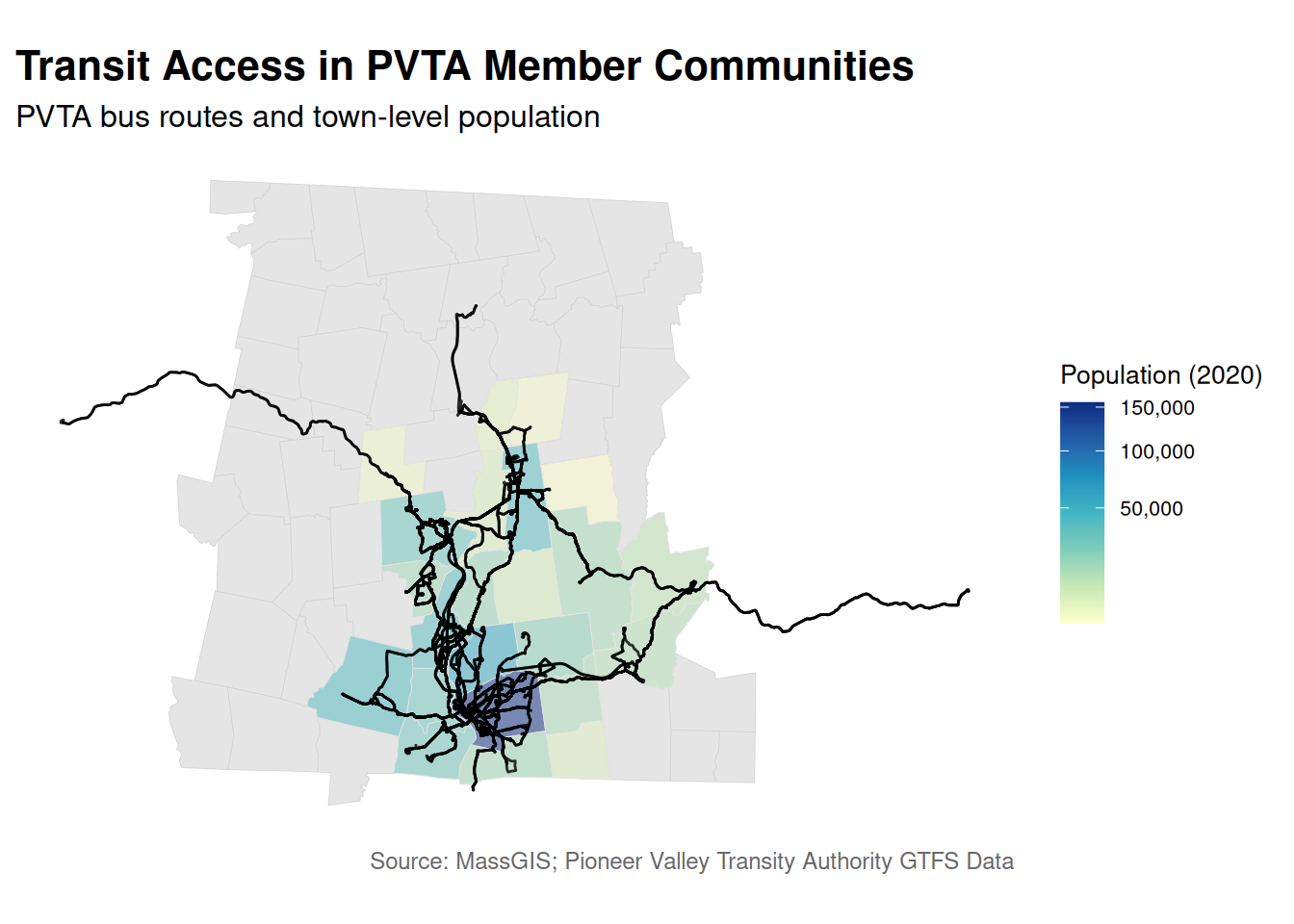
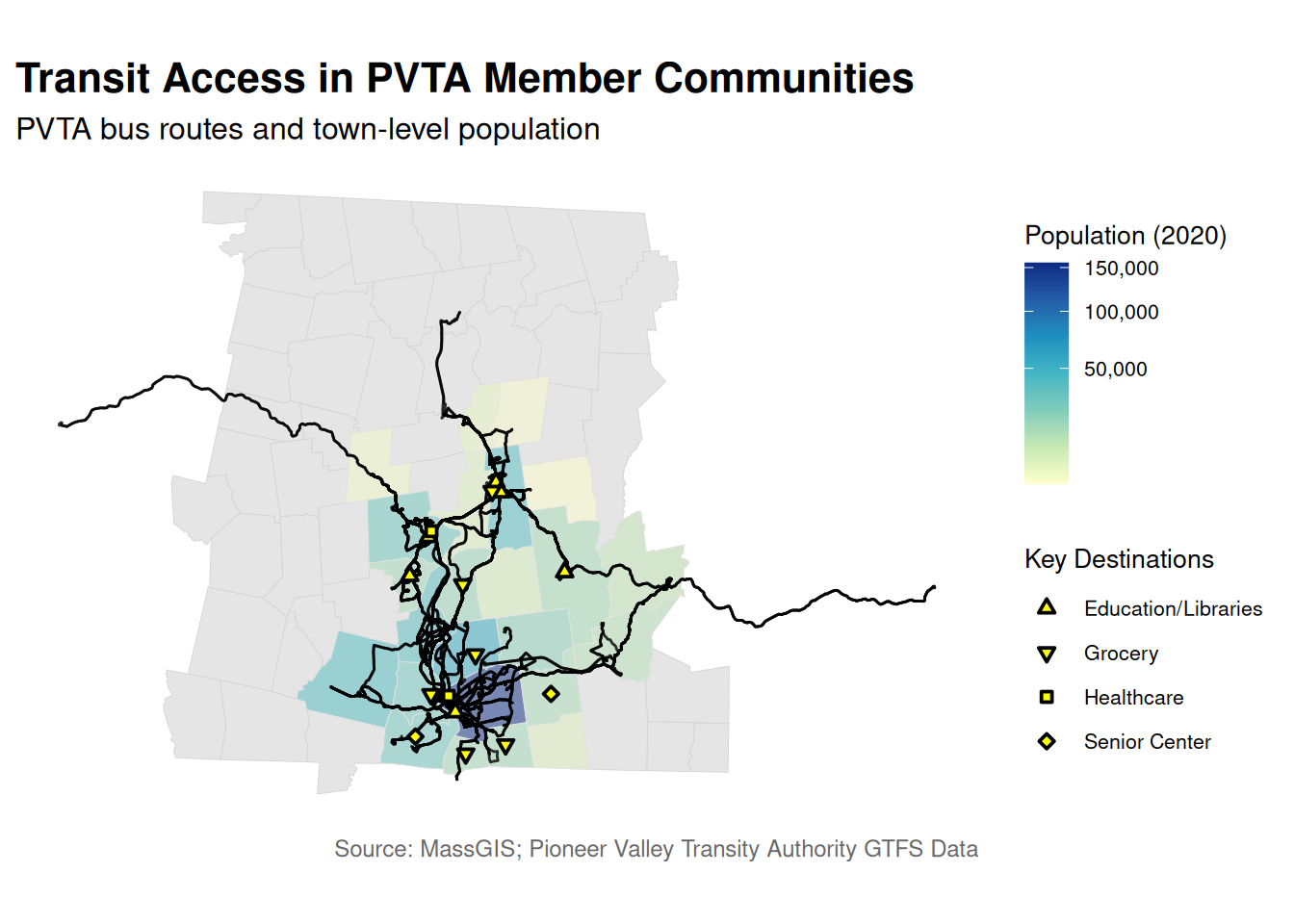
“We have 315,300 people within a quarter mile of bus stops for residences, and we have 153,200 jobs within a quarter mile,” said Alex Forrest, PVTA’s Manager of Planning and Analysis. By that measure, roughly 54 percent of residents in PVTA’s member communities live within walking distance of service, said Forrest.
That leaves nearly half of the region outside of a reliable proximity to transit.
While these figures indicate that a slight majority of households and jobs fall within a walking distance of PVTA service, gaps remain. Survey respondents living in more rural areas, as well as in higher-income, low-density communities, report a lack of bus stops within a reasonable walking distance. This is a significant barrier to PVTA usage in these areas and also raises questions surrounding environmental equity.
According to the Encyclopedia of Environmental Health, environmental equity refers to “the fair distribution of environmental benefits and burdens,” ensuring healthy living conditions for all and addressing inequities through urban planning and policymaking.
The consequences of limited PVTA service extend beyond convenience. In communities where transit is sparse, residents are more likely to rely on cars, contributing to higher per-capita carbon emissions.
This dynamic is particularly relevant as Massachusetts works under the Global Warming Solutions Act to reduce greenhouse gas emissions by at least 80 percent below 1990 levels by 2050. With transportation accounting for roughly 28 percent of greenhouse gas emissions, as noted by the Environmental Protection Agency, increasing ridership amongst state and regional transit systems remains a central challenge to meeting this goal. However, even for riders who live near bus routes, access does not always translate into reliability.
Easthampton resident James Crawford, who is unable to drive due to epilepsy, relies on buses and biking as his main forms of transportation. James said that while buses may run every 20 minutes during the day, service is far more infrequent in later hours, which can be disruptive.
“Sometimes it’s really frustrating when you show up and realize it’s another 45 minutes before the next bus,” he said. “It can impact your entire day.”
Ace Tayloe, a Northampton resident and frequent PVTA user, also pointed to limited evening service as a major barrier.
“My big thing is seeing evening and late night routes,” said Tayloe. “Especially for folks who are working service jobs, being able to get home is the big one for that. One of my coworkers lives in Florence, works in Northampton, and has to drive and pay a parking fee because she can’t get home after her shift via bus.”
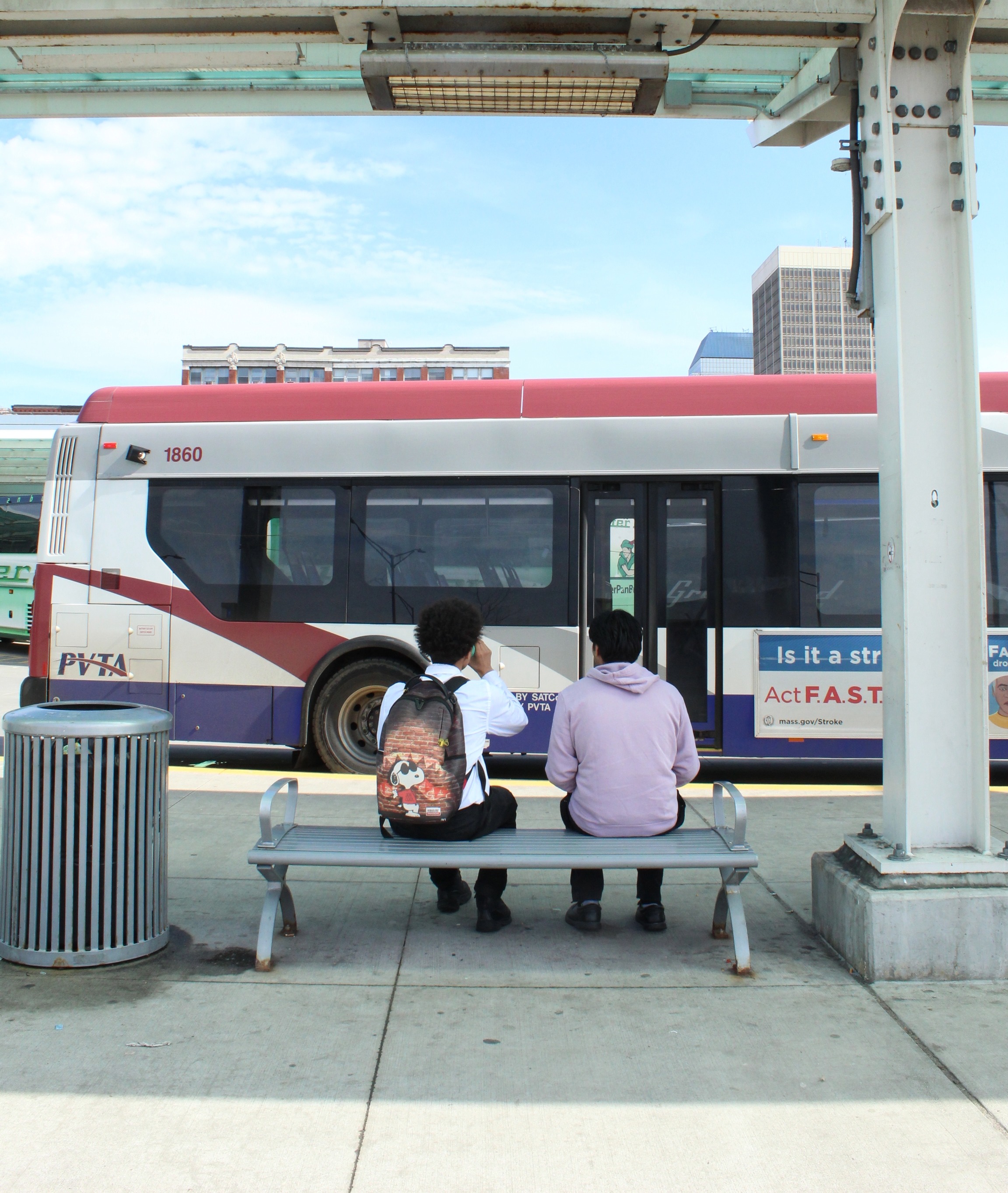
Tayloe also added that riders with more resources tend to be better positioned to push for improvements.
“I think it is important to, you know, convince car-havers to use the bus,” said Tayloe. “Cynically, those are the people with more money.”
This imbalance highlights a central challenge for the PVTA: expanding service into car-dependent communities could reduce emissions, but doing so requires significant investments in areas where ridership demand is less certain.
Future Routes and Budget Constraints
“We have a current administration that is very pro-transit,” said Sheehan, pointing to recent increases in support from the Healey-Driscoll administration. In 2025, Governor Maura Healey announced a transportation plan that would invest $8 billion over the next 10 years in statewide infrastructure, including $110 million for regional transit authorities in the fiscal year 2025-2026 budget.
This funding has created space for planners to begin imagining new routes, including proposed express lines in Ludlow (B6E), Chicopee (G9E), and Westfield (R10E). One potential route— a direct connection between Westfield’s Olver Transit Pavilion and Springfield— is expected to improve access and connectivity for hundreds of thousands of residents.
As a regional transit authority, the PVTA relies on state funding allocated annually through a formula-based system that considers historical costs, service levels, and ridership demand. This funding accounts for 40 percent of the PVTA’s day-to-day operational costs, including maintaining routes and paying drivers.
However, expanding service requires sustained investment in staffing, vehicles, and operating hours. Even with increased state support, those resources remain limited.
While the Try Transit initiative has made riding the bus more affordable and feasible for many, affordability alone does not guarantee accessibility.
As the PVTA looks to the future, the central question is no longer just how to get more people on buses. It is how to build a system that reaches those who need it most, while also reducing the Pioneer Valley’s reliance on cars.
Fare-free transit has removed one barrier. But without expanding when and where buses run, particularly in underserved and car-dependent areas, it risks benefiting those already within reach while leaving others behind.